Nara Tanzania Safaris

Usa River, Arusha · Tanzania +255 652 135 520 info@naratanzaniasafaris.co.tz

NaraTanzania Safaris Plan your safari
Stone Town - 2400x1500 Stone Town hero - 2400x1500

Stone Town

A living maze of coral-stone alleys, carved doors and layered history — the ancient heart of Zanzibar and one of the great Swahili cities.

UNESCOWorld Heritage Site1,000 yearsOf trade & cultureSwahiliArab & Indian heritage

01 The place

Stone Town, in short.

Stone Town is the old heart of Zanzibar City and one of the most atmospheric places in East Africa — a dense labyrinth of narrow alleys, coral-stone buildings and carved wooden doors that has grown over centuries at the meeting point of African, Arab, Indian and European worlds. A UNESCO World Heritage Site, it is the finest surviving example of a Swahili trading town, its architecture and street life a living record of a thousand years of Indian Ocean commerce. To wander its shaded lanes, losing your way among mosques, bazaars and crumbling merchant houses, is to walk through history.

But Stone Town's story is not only romantic. It was, in the nineteenth century, the largest slave-trading port in East Africa, and that history is confronted honestly at the site of the old slave market, now a moving memorial and cathedral. The town was the seat of the Omani sultans who ruled Zanzibar, the base from which explorers like Livingstone and Burton set out for the interior, and the birthplace of figures from the Sultan's court to Freddie Mercury. Layered, complex and endlessly photogenic, Stone Town is the cultural counterweight to Zanzibar's beaches, and a destination in its own right.

02 The coast

Nature & the sea.

Stone Town is a city, not a wildlife destination, but its setting on the Indian Ocean and its position at Zanzibar's heart put nature within easy reach. The waterfront and harbour are alive with the comings and goings of dhows, and the seafront at Forodhani is where the town meets the sea, especially at sunset. Just offshore, small islands like Changuu (Prison Island) are home to a colony of giant Aldabra tortoises, some over a century old, and fringed with reef for snorkelling — a popular short boat trip from the town.

From Stone Town it is a short journey to Zanzibar's natural highlights: the Jozani Forest and its endemic red colobus monkeys lie less than an hour away, and the reefs and beaches of the coast are within easy reach for day trips. The town itself rewards a different kind of watching — the swifts wheeling over the rooftops at dusk, the cats in the alleys, the life of a Swahili port going about its day. Stone Town's appeal is human and historical, but the ocean and the island's nature are never far.

03 When to go

The best time to visit.

Stone Town can be visited year-round, and as a cultural destination it is less weather-dependent than the beaches, though the dry seasons are most comfortable. June to October brings warm, dry, pleasant days ideal for walking the town, and is the peak time. December to February is hot and sunny, lively over the festive season, and a fine time to explore in the mornings before the midday heat.

The long rains from March to May are humid and wet, the quietest time, when heavy showers can interrupt sightseeing, while the short rains around November bring brief afternoon downpours. Stone Town is also a place of festivals — the Sauti za Busara music festival in February and the Zanzibar International Film Festival around June or July draw visitors and fill the town with energy. For comfortable walking weather, the dry months are best, but the town's covered alleys and indoor sights make it rewarding in any season.

An intricately carved wooden door - 2400x1350 Stone Town band - 2400x1350

A living maze of coral-stone alleys, carved doors and layered history — the ancient heart of Zanzibar and one of the great Swahili cities.

04 The regions

Around the island.

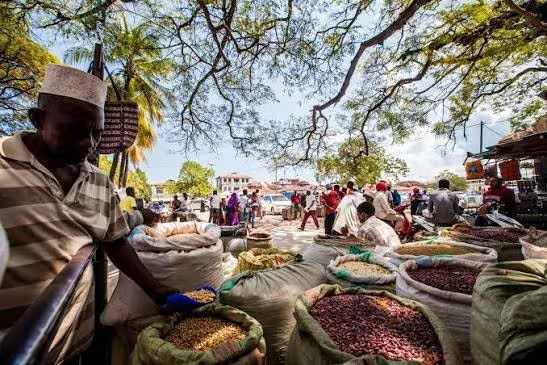
Stone Town is compact and best explored on foot, its character concentrated in a few key areas. The seafront, along Mizingani Road, holds the grandest buildings — the Old Fort, the former House of Wonders, and the sultans' palaces — and the Forodhani Gardens, where the famous night food market sets up each evening. The old commercial core, around the bazaars and the Darajani Market, is the town at its most vivid and chaotic. The area around the Anglican Cathedral marks the site of the old slave market and its memorial. And threading everywhere are the residential alleys, where the carved doors, coral-stone houses and quiet courtyards reward slow, aimless wandering.
The Seafront - Stone Town - 1200x900Region - The Seafront - 1200x900

The Seafront

The grandest buildings — the Old Fort, House of Wonders and palaces — and the Forodhani night market.

The Old Market Core - Stone Town - 1200x900Region - The Old Market Core - 1200x900

The Old Market Core

The bazaars and Darajani Market, the town at its most vivid and chaotic.

The Slave-Market Memorial - Stone Town - 1200x900Region - The Slave-Market Memorial - 1200x900

The Slave-Market Memorial

The site of the old slave market, now a moving memorial beside the Anglican Cathedral.

The Residential Alleys - Stone Town - 1200x900Region - The Residential Alleys - 1200x900

The Residential Alleys

Winding lanes of carved doors, coral-stone houses and quiet courtyards to lose yourself in.

05 Getting there

How to get there.

Stone Town is Zanzibar's gateway and is easily reached. Abeid Amani Karume International Airport lies just a few kilometres away, served by direct international flights and very frequent short hops from Dar es Salaam (around 20 minutes) and the northern safari circuit. Ferries from Dar es Salaam dock right at the edge of the old town after a crossing of about two hours. Once there, Stone Town is explored entirely on foot — its alleys are far too narrow for cars — and it serves as the base from which to reach the rest of the island, with the beaches of the north and east an hour or so away by road. Most Zanzibar trips begin or end here.

07 The route

A sample Stone Town few days.

Day 01

Arrive in Stone Town

Arrive by air or ferry and settle into a historic Stone Town hotel, spending the first evening at the Forodhani night market by the waterfront as the sun sets.

Day 02

Historic walking tour

A guided walking tour of the old town — the Old Fort, the House of Wonders, the sultans' palaces, the former slave market and its memorial, and the maze of alleys and carved doors.

Day 03

Prison Island & the market

A morning boat trip to Changuu (Prison Island) to see the giant tortoises and snorkel the reef, and an afternoon exploring the Darajani Market and bazaars.

Day 04

Onward to the beach

With the culture explored, transfer to the beaches of the north or east coast, or fly onward.

08 Questions

Stone Town travel questions.

Stone Town is known as the historic heart of Zanzibar — a UNESCO World Heritage Site and the finest surviving Swahili trading town. It is famous for its maze of coral-stone alleys, intricately carved wooden doors, layered African-Arab-Indian culture, and its sobering history as East Africa's largest nineteenth-century slave-trading port.
The highlights include a guided walking tour of the old town (the Old Fort, House of Wonders, sultans' palaces and slave-market memorial), the Forodhani night food market, the Darajani Market and bazaars, a boat trip to Prison Island for the giant tortoises, and simply wandering the alleys to admire the carved doors.
One to two days is enough to see Stone Town's main sights, usually at the start or end of a Zanzibar trip. A full day for a historic walking tour and the market, plus a half-day for Prison Island or simply wandering, lets you take in the town before heading to the beaches.
Yes. Stone Town is one of the most atmospheric and historically significant places in East Africa, offering a rich cultural and historical counterweight to Zanzibar's beaches. Its architecture, markets, layered heritage and honest confrontation of its slave-trade past make it a genuine destination in its own right.
Stone Town is reached via Zanzibar's international airport, a few kilometres away, with direct international flights and frequent short hops from Dar es Salaam (around 20 minutes) and the safari circuit. Ferries from Dar es Salaam dock at the edge of the old town after about two hours. The town itself is explored on foot.
Stone Town was the largest slave-trading port in East Africa in the nineteenth century. The site of the old slave market is now a memorial beside the Anglican Cathedral, built where the market once stood, with an underground chamber that held enslaved people and a moving monument — an essential, sobering part of understanding Zanzibar's history.

Ready to see Stone Town?

Tell us how you want to travel and a guide in Arusha will build you a route - within 24 hours, from a person, not a brochure.

Loading itinerary…
Saved Trips